Thursday, December 9, 2021

City Hall's Sausage Machine


Portland City Hall (Circa 1915)

There is a dispute about who first compared sausage-making to the legislative process in the 1800s, but it doesn’t matter; the essence still holds.

 Heading into the final stage of revising Portland’s rules for regulating historical landmarks and historic districts, two city commissioners have suggested three amendments that finally provide some hope for the preservation community.  In short, the sausage may have a better flavor as a result.

Two proposed amendments from Commissioner Mingus Mapps would thwart attempts by the city Planning and Sustainability Commission to restrict recommendations from the Portland Historic Landmarks Commission to the City Council, and to dilute the professional qualifications required of landmarks commission members.

One Mapps amendment would leave qualifications for landmarks commissioners the same as they have been for the past 50 years.  The other would give both the landmarks commission and the PSC equal opportunities to advise the City Council on matters involving proposed new historic districts or reducing the size of current districts.  Recent history makes it clear that the developer-driven PSC as now composed likely would never support historic preservation. 

 Both of these amendments are consistent with good public administration and should be adopted by the council.  It remains to be seen, however, whether three votes from the five council members can be mustered in support. A vote likely will be taken on Dec. 15, so time is limited for the preservation community to express support for these amendments by email to city commissioners or by oral testimony on the 15th.

You can sign up to testify to the City Council via Zoom.  Register here:

https://us06web.zoom.us/webinar/register/WN_S1s7hjhvSU2jtgSIb3VzsA

Another vital amend, this one from Commissioner Carmen Rubio, would revise rules for deciding when to demolish a landmark by removing a current standard allowing demolition when a building has “no reasonable economic value.”  We believe the “no economic value” standard can promote intentional neglect by an owner wanting to demolish an important historical structure by ignoring routine maintenance.

The importance of the “no reasonable economic value” rule came to the City Council’s attention recently in the case of the Yamaguchi Hotel building that later served as home of the Blanchet House charity that provides food and shelter for the needy.  After moving to a new building Blanchet House did little or nothing to maintain the old building and then sought demolition saying it no longer had economic value.

 The Rubio amendment lists several criteria that would be weighed in deciding whether to demolish a historic building.  They would include the economic status of the building as well as its age, condition, historic integrity, historic significance, design or construction rarity, options for rehabilitation, or reuse of the resource and value to the community and association with historically marginalized individuals or communities.  In addition, the city could consider the merits of a development proposed to replace the historic property.

 Those are all genuine, legitimate factors to be considered.

There are eight proposed to the Historic Resources Code Project, but the three addressed here are the most important for the preservation community.  They are numbered 3, 5 and 6 on the list. 

Those of you willing to support proposed amendments 3, 5 and 6 can email your support to council members listed below.  Don't wait; there is little time left.  I could not find a working email address for Mayor Ted Wheeler.  

Commissioner Carmen Rubio Comm.Rubio@portlandoregon.gov

Commissioner Dan Ryan CommissionerRyanOffice@portlandoregon.gov

Commissioner Mingus Mapps MappsOffice@portlandoregon.gov

Commissioner Joann Hardesty joann@portlandoregon.gov

 -----Fred Leeson

 Join Building on History’s mailing list by writing “add me” to fredleeson@hotmail.com


Friday, December 3, 2021

South Park Blocks (Chapter 5)


(State Advisory Committee on Historic Preservation)

 Though consequences are yet unclear, a devoted group of volunteers trying to save historic fabric of one of Portland’s oldest parks has won a major step toward placing the South Park Blocks on the National Register of Historic Places.

 A 5-1 vote by the State Advisory Committee on Historic Preservation on Nov. 30 was a hard-fought victory for the Downtown Neighborhood Association that sponsored the nomination, and a setback of sorts for the Portland Parks Bureau and Portland State University who opposed it.

What remains murky is the effect the designation could or would have on the Parks Bureau’s 50-year masterplan that would allow gradual death of dozens of historic deciduous trees, add conifers, change walking paths and impair the historic landscape plan with its five axial tree rows.  Despite substantial public opposition, the City Council earlier this year approved the plan for the 12-block stretch of narrow park blocks in Southwest Portland, even though there is no budget yet for making the proposed changes.

Four earlier posts on Building on History were devoted to master planning and its consequences.   earlier. 

If the park were a “building” instead of a park, substantial proposed changes would have to undergo a historical review to assess whether changes were necessary and historically appropriate.  However, there apparently is no such standard under the federal rules for public parks.  And even if major changes were to require historical review, it is probably that a series of smaller changes could slip through piecemeal. 

 A knowledgeable preservation expert predicts the city will "do everything possible to minimize" the impact of the designation.  

 On preservation’s plus side, a national listing would mean that no federal funding could be used for park improvements without historic review.  And advocates trying to preserve the park in years ahead can use the extensive historical document to lobby future City Councils against disruptive changes.  There is always a chance that future City Councils will pay more attention to the importance of historic public spaces rather than deferring to special interest groups that promoted the 2021 master plan. 

 The 12 park blocks were donated for park use in 1852 and planted in 1877 with five axial rows of deciduous trees, mostly elms, running north and south.  Those rows are largely intact today, with trees being replaced when necessary.  Although often used for public events, the blocks are noted mostly for the quietude the offer in the heart of a busy city. 

 A Portland State University official opposed the designation on grounds that the southern six blocks are now part of the PSU campus.  He also contended that a designation would hinder PSU’s ability to make changes needed for students of varying disabilities.  Heidi Slaybaugh, one of the state committee members, noted however,  that “there are many ways to provide accessibility in a historic park or a historic building.”

The detailed and heavily-documented nomination report was written by volunteer historical consultants  Brooke Best and Kirk Ranzetta.  They were assisted by a handful of volunteers who helped with  research and graphics.  Wendy Rahm, a neighborhood association board member, recruited, managed, cajoled and encouraged the volunteers in an extraordinary example of citizen participation.

The nomination  is based on the history of planning and development for Portland parks and for the distinctive landscape architecture.  

Given the recent preoccupation with ethnic awareness and inclusion, the nomination includes a concise narrative of indigenous history before the park was created.  Nevertheless, the Parks Bureau, which steadfastly opposed the nomination, asked for “a more nuanced narrative" -- whatever that means.  

Stephen Beckham, a well-known Pacific Northwest historian who chairs the state committee, seemed to push back on what might be an idyllic view of native life in and around the Park Blocks.  He listed tribes in Western Oregon that engaged in slavery, and noted that when first surveyed in the 1850s, the Park Blocks were composed of dense, old-growth trees showing no signs of human habitation.

The one vote cast against the National Register nomination was from John Arroyo, an assistant professor at the University of Oregon.  He said the number of “non-contributing” elements in the blocks outnumbered the historical contributing elements.

 In other action at the same meeting, the state committee approved National Register nominations for three buildings closely associated with African American History in Portland:  Mt. Olivet Baptist Church, Golden West Hotel and Dean’s Beauty Salon and Barber Shop.   Photographs of those buildings and descriptions of their importance were detailed here on Sept. 19.  You can see the posting below: 

https://buildingonhistory.blogspot.com/2021/09/african-american-cultural-landmarks.html

----Fred Leeson

Join Building on History’s mailing list by writing “add me” to fredleeson@hotmail.com 


Friday, November 26, 2021

Visiting the Lloyd Center Ghost Town


If you’re a fan of oversized fake Christmas trees and huge dangling ornaments, don’t miss Lloyd Center this season.  It’s bound to be your last chance.

A year ago, Building on History wrote about the obvious decline of the big Northeast Portland shopping mall and offered suggestions for its future.  Other news outlets picked up on the story, leading to an outpouring of memories of shoppers who remember the mall in its prime.  While this blog generally concentrates on preservation of older buildings, the number of "hits" for the Lloyd Center post far exceeded any other in the blog's lifetime. 

 Portland author and filmmaker, Paula Bernstein, was so touched by peoples’ memories of the mall that she is working on documentary about them.  Her production schedule is not yet known, but there is a strong chance the mall will be padlocked before it’s finished.  Interested people can reach her through https://www.paulabernstein.com/

In the meantime, the months have been difficult at the mall.  None of us knew a year ago that the Texas-based owners were already defaulting on their big debt to a powerful lender, who has now promised  foreclosure after the December seasonal “rush” concludes.

  A fire in the electrical station shut down the mall for a few weeks in the summer, and more stores have departed.  Managers of those that remain have heard nothing from the mall owner about the mall’s future.

KKR Real Estate Finance Trust said it plans to take possession “and prepare for long-term redevelopment of the site.”  What that means is anyone’s guess.  

The only obvious answer is that the mall’s future, like most other issues on American society, will be decided by Big Money.  You can be sure KKR isn’t interested in housing the homeless or maintaining a goofy little skating rink because a handful of people like it.  It also is improbable to think the mall could be reconditioned as a retail site, given the decline in on-site shopping in favor of the internet. 

The likelihood is that the mall will be replaced by towers for offices and affluent condominium owners, if private studies show there is suitable market for them.  Lloyd Center was an anomaly in the city's traditional grid layout in that it was a "superblock" imposed in the late 1950s on approximately 17 square blocks of "old" Northeast Portland.  It would be interesting to see streets blocked off by the mall be reopened to Portland’s traditional grid pattern.  That outcome might open the door for interesting and active street life in the neighborhood.  Or not.

In the meantime, take in the fake tree and monstrous dangling ornaments if they fit your fancy.  While you can.  

 -----Fred Leeson

Join Building on History’s mailing list by writing “add me” to fredleeson@hotmail.com


Friday, November 19, 2021

Good News at Hollywood Theatre


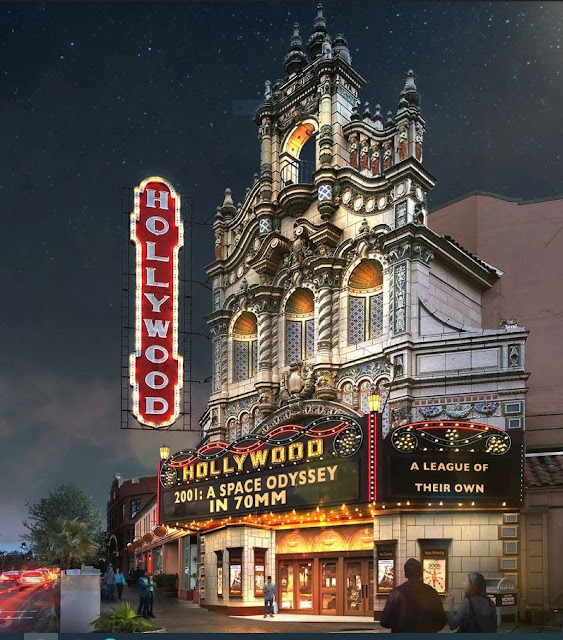
Artist's rendering (Scott Baumberger)

 After a COVID-19-related delay for 15 months, officials restoring the Hollywood Theatre in Northeast Portland are getting ready – again – to start restoration of the pedestrian-level façade.

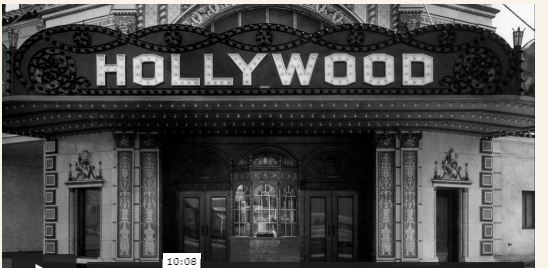
 Workers are slowly peeling away fabric installed in 1965 under the big marquee when most of the original terra cotta details and original ornaments were either scraped off or covered over, presumably to give the erstwhile movie palace a more modern look.

 When it opened in 1926, the glorious and intricately-decorated tall big façade on Sandy Boulevard made such a big impression that the neighborhood for blocks around came to be known as the Hollywood District, a name that it still bears today.

 The pandemic-related delay to the $150,000 lower façade project proved to have some benefit, as it allowed time to find some original details that were thought to be lost.  Three bas reliefs in arches over the entry doors were thought to have been destroyed, but were merely covered up.  Likewise, a patch of original terrazzo tiles hidden by the earlier remodel will allow for new tiles to be ordered with the right colors.

Yet another surprise was found in what architect Paul Falsetto called the large barrel arch on the façade that is partially covered by the Hollywood marquee.  Colorful terra cotta decorations thought to have been lost in the arch turned out to be largely intact when subsequent screening was removed.


Historic view (Hollywood Theatre)

"I'm related elated about these discoveries," said Virginia Durost, the Hollywood facilities director.  “We’ve gotten to see what was under there before we start.” She said the original building was “designed as one cohesive whole,” but was "cut off at the knees" by subsequent remodels at the ground level.  The new project will not be an exact replica of the original, but it will be close enough to make the building stand as a unified architectural statement.  “The whole design will come down to the ground,” Durost said. 

An element that will not be replaced is the freestanding octagonal ticket booth that originally stood close to the Sandy Boulevard sidewalk.  However, its shape and location will be recognized on the ground in the entryway.

In a Zoom meeting, Falsetto said the lower façade improvements will restore the original symmetry, although not all of the detailing will be identical.  Stacks of what look like blocks, called quoins in architectural lingo, will define the east and west edges of the lower façade, and lighted poster cases will be set off against sleek porcelain bricks.

 The firm of John Virginius Bennes and Harry Herzog did the original design.  The two men were partners for nine years, during which they designed two other theaters that no longer exist.  Bennes is best known for several buildings he designed on the campus of Oregon State University that are included in a national historic district; Herzog also worked on Temple Beth Israel, another of the city’s most notable structures. 

The glitzy façade of the Hollywood Theatre is one of the best-known in Portland.  Falsetto said the  main entrance was angled along Sandy Boulevard – a street  that cuts through Northeast Portland on a diagonal -- so that it is especially visible to traffic heading east on Sandy, another reason for the building’s prominence.

 The non-profit Hollywood Theatre organization is now in its 11th year of gradually restoring the previously much-abused landmark.  By early next spring, if construction estimates are accurate, the exterior of the grand dame of Northeast Portland should be proud and shining again for many years to come.

Besides its devotion to showing new and old movies, the nonprofit deserves high regard for its careful persistence in restoring a magnificent architectural treasure.  

 -----Fred Leeson

You can join Building on History’s mailing list by writing “add me” to fredleeson@hotmail.com


Friday, November 12, 2021

Revisiting the Yamaguchi Hotel


340 NW Glisan St. 

The drama over demolition of the old Yamaguchi Hotel, later used as the first Blanchet House of Hospitality, didn’t end with the City Council’s decision in July to allow demolition of the 116-year-old building.

The council’s ruling was appealed to the state Land Use Board of Appeals by two preservation organizations and the Japanese American Museum of Oregon.  Their first motion was to stay the demolition while a full appeal could occur that attacked the council’s grounds for allowing demolition.

As Yogi Berra, the great Yankee catcher allegedly said, “It ain’t over until it’s over.”  Except now it is getting closer. 

Pretrial negotiations led to a settlement in which the Blanchet House, a nonprofit that provides food and some housing to the indigent, agreed to save elements of the old building before demolition.  The pieces ostensibly can be incorporated into a new structure on the same site, or used elsewhere as part of a historic display.

The settlement states:

“At its sole cost and expense, Blanchet House will use all commercially reasonable methods and best management practices in the demolition of the 340 NW Glisan St. building to preserve the following historical elements of the Building:

·         “Exterior building doors and frames on Glisan Street Frontage, including transoms;

·         “Wood components of ground floor storefront system on Glisan Street frontage, including frames and sills;

·         “Wood components of upper level windows on Glisan Street frontage, including frames, sills, sashes, arched header and interior casings;

·         “Iron columns immediately behind the Glisan Street ground floor storefront;

·         “At least 100 original bricks.”

As part of the settlement, the Land Use Board of Appeals will reimburse Restore Oregon and the Architectural Heritage Center for $5,000 in legal fees.

It is easy to say the settlement nets only bits and pieces of what the appellants originally wanted.  On the other hand, it amounts to a “win” in that some of the historic fabric will be saved – a result that went beyond the City Council’s ruling.

During its tenure as the Yamaguchi Hotel, the building was a beacon for Japanese residents who during its 25-year span were subjected to immigration restrictions and bans, and were prevented from buying or owning property.

Oddly, the Blanchet House, a respected nonprofit with an excellent reputation for its work, apparently knew little or nothing about the Japanese history associated with the building.  The structure is listed as a contributing element in the 10-square-block Portland New Chinatown/Japantown National Historic District

“The settlement agreement is better than if no appeal had been initiated,” said Larry Kojaku, a board member of the Architectural Heritage Center.  He added, however, that a better long-term solution would be for the city to not consider demolishing a historic landmark without assessing the comparative value of a proposed building to replace it.  That is the standard recommended the Oregon State Historic Preservation Office.

Ironically, Blanchet House went through that exact procedure when it convinced the city to demolish another building in the historic district to make way for the new (current) Blanchet House adjacent to the old one. 

In this case, the Blanchet House did not offer a specific proposal in return for demolition.  At one point it did suggest building a community health center on the site, but there was no assurance that the old building would be more than vacant land for the foreseeable future.

At the City Council’s direction, Blanchet House is continuing to meet with a committee of historians and neighborhood leaders to discuss what should happen at the old Blanchet House site.  In an ideal world, they would find a way to rehabilitate the building so it could provide a community health center and  more housing for the Blanchet clientele. 

-----Fred Leeson

You can join Building on History's mailing list by writing "add me" to fredleeson@hotmail.com


Friday, November 5, 2021

Preservation Battle: Same Old, Same Old (So Far...)

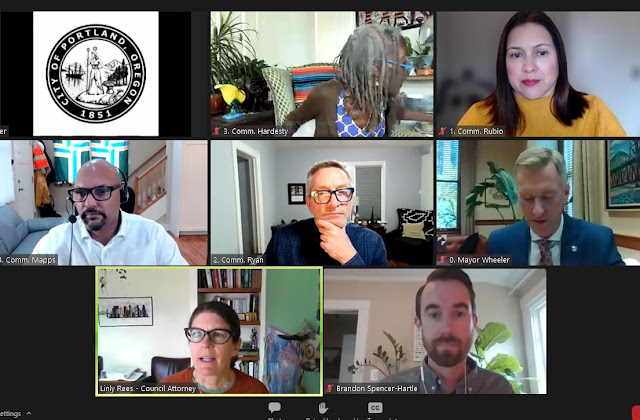
Portland City Council (top two rows)

 Six hours of testimony before the Portland City Council this week reflected all the heat and little new light about changing how the city identifies and manages its historic landmarks and historic districts.

 The arguments for and against historic preservation showed little new from prior years, with the notable exception of who DIDN’T show up.

The homebuilders’ lobby and One Thousand Friends of Oregon, originally a farmland preservation group, have led the fight against historic districts for several years now.  They appear to have been replaced by new faces using the same talking points under the label Portland Neighbors Welcome.

Their pitch contends that historic districts stand in the way of affordable housing, and that standards for demolishing buildings for new development should be made easier. They want fewer building restrictions, faster government approvals and relaxed height standards.  They offer no proof, however, that their amendments create affordable housing. 

If there was truth in their contentions, you would think we would see results in many Portland neighborhoods where no historic standards are maintained.  Alas, we don't. 

 Lincoln Tuchow, a Portland Realtor, testified that rents in the plethora of new apartment buildings are more expensive than rents in old buildings.  He also said that whenever an old house is demolished, the unit that replaces it is more expensive. 

Both preservation advocates and the construction lobby have offered to the City Council amendments to the proposed Historic Resources Code Project under discussion.  The council is supposed to declare by Dec. 1 which, if any, amendments they want to consider at a council meeting on Dec. 15. 

It would be reading tea leaves to guess at this point if any amendments will be proposed.  Since three of the five commissioners are in their first year on the council, there is a perception that the "newbies" are unwilling to challenge measures brought to the council by another, for the sake of maintaining personal  relationships.  Alas, if that's true, it puts good public policy in potential jeopardy. 

As part of the lengthy hearing this week, Rod Merrick an architect and preservation advocate, listed 10 reasons why preservation is important.  If you happen to be new to the world of preservation they amount to a brief, informative primer.

1.       Preservation guides change to protect historic resources -our architecture, landscapes, and culture. 

2.       Preservation is environmentally and ecologically the most sustainable form of development.  

3.       Preservation promotes local craft skills and the local business that supply products for those crafts. 

4.       Preservation of existing structures limits demolitions that are the largest volume of material that is trucked to landfills. 

5.       Preservation protects the treasures of a city for the education and enjoyment of visitors and fellow residents. 

6.       Preservation promotes the sense of place that builds community and civic pride. 

7.       Preservation drives tourism world-wide. Portland is very much in need of preserving its appeal beyond providing a landing place for exploration of the beautiful landscapes beyond the Metro boundaries. 

8.       Preservation attracts investment in unstable and declining neighborhoods. 

9.       Preservation is an expression of appreciation and provides soul to every place where it is practiced. 

10.   Historic Preservation districts affect less than 3% of Portland's housing stock. They contribute to housing affordability by:

a.       Preserving existing housing stock which is often the most affordable housing

b.      Curbing speculative upmarket redevelopment

c.       Discouraging demolition and displacement.

Friday, October 29, 2021

Reviving Grace Peck Terrace


Grace Peck Terrace

 The Irvington National Historic District wasn’t even a gleam in anyone’s eye in 1979 when the Housing Authority of Portland designed and built the six-story Grace Peck Terrace for low-income seniors and residents with disabilities.

 Forty years later, the 95-unit apartment building suffers from water infiltration in its window frames and its stucco facades.  What might be described as a "low-budget modern" architectural style does not fit well with the houses and apartment buildings from the early 1900s to 1920s that surround it.

 The good news is that Home Forward (nee: Housing Authority) wants to upgrade the building with facades and windows that shed water better and provide a more compatible appearance with the historic neighborhood.

 Granted, the Grace Peck will never be confused with an old building.  However, different materials and colors could create a better fit in the district. “We want a much more durable and sustainable façade,” Dave Otte, a principal with Holst Architecture, told the Portland Historic Landmarks Commission during an advisory meeting. 

Thin-brick version with window bands (Holst Architecture)

Holst presented two potential revisions for the whole building.  The first featured thin bricks on most of the walls, and wider bands of windows on the five residential floors.  A second option favored narrow strips of oko skin, a fiberglass reinforced concrete cladding material, with a more random pattern of windows.  A common element in both schemes was enclosure of 61 small balconies that extend from apartment interiors to the outer walls.

Otte said eliminating the balconies would give tenants greater flexibility in arranging furniture and eliminate any friction among tenants as to which ones have balconies and which ones don’t.  Based on testimony from one resident, however, the landmarks commission preferred to see the balconies remain – and asked if there was a means for providing balconies for ALL apartments.  At present, the balconies amount to about 20 square feet each – but provide enough room for pots for flowers or tomatoes. 

Oko skin version (Holst Architecture)

The commission did not take a formal vote on the proposals, but by consensus preferred the oko skin plan better than the one with thin bricks.  The horizontal oko cladding would be a visual nod to the lap siding common om most houses nearby.  Some members felt the first version with the wider window bands would make the building look too much like an office building.  Jannel Waldron, a Holst designer, said the option with oko skin allows for “a more playful pattern to the windows.

 Holst is expected to return to the landmarks commission sometime in the next few months with a final proposed design.

 Portland’s proposed historic code revisions come to the City Council on Nov. 3.  Preservation advocate Constance Beaumont offered the following:

 While a number of the proposed rule changes have been welcomed by the preservation community, others have raised concerns.  Among the latter:  

  • diluted requirements for relevant expertise on the part of Historic Landmarks Commission members;  
  • a stronger role for the Planning and Sustainability Commission, which has been hostile to preservation in recent years, and a weaker role for the Historic Landmarks Commission; and  
  • new criteria for demolition approvals in historic districts.   

It will be important for those who support the preservation of Portland’s historic and architecturally significant resources to weigh in on the HRCP proposal and to emphasize to Council the value of these resources to the city as a whole.  

Given the upcoming hearing on November 3, I wanted you to know ASAP about several backgrounders available on-line to help those interested in submitting testimony:

 You can join Building on History’s mailing list by writing “Add me” to fredleeson@hotmail.com 

Friday, October 22, 2021

Progress on a New Burnside Bridge


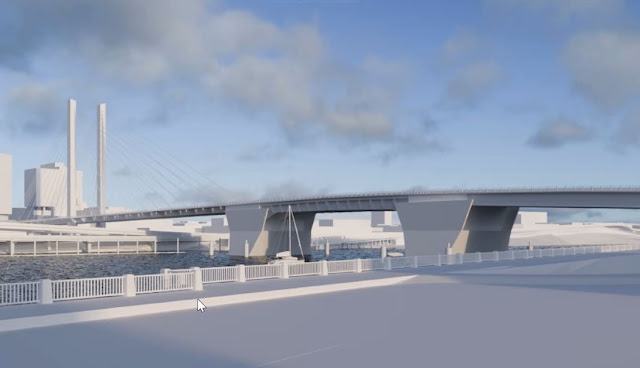
Tied Arch Version (Multnomah County)

Even though funding sources and a specific budget are not yet known, designers of the proposed new Burnside Bridge are looking at ways to cut costs.

 So far, the likeliest cost-savers are slimming the bridge width from five vehicular traffic lanes to four, and narrowing pedestrian/bicycle lanes from 20 feet widths to 15.5 feet on both sides.

That said, a couple major decisions appear to have been reached in designing a bridge to replace the earthquake-vulnerable existing bridge, which is nearly 100 years old.   The west end running to and from the Skidmore-Old Town National Historic District is to be supported by long girders, extending to the mid-river bascules that allow the bridge to open for river traffic.  This design has minimal visual impact as motorists and others travel westward into Old Town.

 Bridge planners also have decided that bascules – which allow the bridge to open and close using counterweights below the roadway – are the preferred system handling river traffic.  The bascule system would be similar to how the bridge operates today, but would be entirely new mechanically.

The new bridge could be Portland's only bridge capable of handling major traffic after a high-intensity earthquake.  That is the primary reason for scrapping the current bridge. 

 The final major planning decision for the new bridge is how to handle the “long span” from the bascules to the east end of the bridge at Martin Luther King Jr. Boulevard, crossing the I-5 freeway and Union Pacific Railway tracks.  It is squishy soil under the Willamette River’s east bank that renders the current bridge violently broken in case of a major earthquake.  The soft soils extend as much as 200 feet below the surface.

 Two options being studied for the eastern portion included a tied arch structure, akin to the big arch of the Fremont Bridge, and a cable-stayed option akin to the structure of Tillicum Crossing.  The option chosen could have a large impact on the final budget, but the appearance of the structure itself would be a landmark – for better or worse – in the center of Portland for many decades to come. 


Cable-stayed Version (Multnomah County)

 It is reasonable to guess that the ultimate choice could pit aesthetics against costs.  A final recommendation is expected next February, with the rest of 2022 being devoted to the final design.  Megan Neill, engineering services manager for Multnomah County, said a funding strategy has yet to be defined. 

 She said a federal infrastructure plan proposed by President Biden is likely to be one component, but she added, “We’ve always known we have to fund additional funds.”  As a start, county motorists are already paying bridge fees when renewing their vehicle licenses.

 CLARIFICATION: Last week’s screed about Portland’s proposed overhaul of rules for adding or removing historic landmarks and landmark districts missed a key point that could be a benefit to preservation advocates.  The proposed rules streamline the process and reduce costs for seeking landmark status for individual sites, and recommendations to the City Council would be made by the Portland Historic Landmarks Commission.

However, the Planning and Sustainability Commission would be the body involved in recommending additions or changes to historic districts.  Given the makeup of the current commission, is it’s laughable to think they would propose anything but reductions to the city’s landmark districts.

 ---Fred Leeson

 You can join Building on History’s mailing list by writing “add me” to fredleeson@hotmail.com


Friday, October 15, 2021

Preservation: Hard Times Ahead


A long political war of attrition against architectural preservation and historic districts by the Portland homebuilding lobby returns for what could be a developers’ triumph at a Portland City Council hearing that begins Nov. 3.

A major revision of Portland’s rules for designating and protecting city’s historic landmarks would dilute the membership and authority of the Portland Historic Landmarks Commission, and cede more responsibility for historic matters to the developer-driver Portland Planning and Sustainability Commission.

Assuming they are approved, the changes probably will make it harder to create new historic landmarks and allow the city to chip away at the city’s existing districts, either block by block, building by building or by elimination entirely.  Gossip also suggests that amendments may be offered to the City Council that are even more severe than the proposed code changes. 

The proposed rules, in concert with earlier changes by the Oregon Legislature, whittle away at protections in National Historic Districts to varying degrees, depending on when the districts were approved by the National Park Service. 

 In reviewing proposed reductions in historic districts, the Planning and Sustainability Commission could advise the Council that the goals and policies of the city’s Comprehensive Plan are “equally or better met” by reducing the level of historic protection.  For a commission incessantly oriented toward new development, that clause is a loophole big enough to make room for bulldozers.  

 The revisions include many goals sought by the developers for the past seven years or so at City Hall and at the state Legislature.  Economic, environmental and historic values as mean little to the developers, whose primary desire is to demolish old houses and built expensive new housing in Portland’s popular National Historic Districts, such as Ladd’s Addition, Irvington and Northwest Portland’s Alphabet District.

 Interestingly, the current Landmarks Commission member are not expected to oppose the new rules.  Kristen Minor, the landmarks chair, said some aspects were “a bit of a surprise,” but added, “There are some really great things in their as well as some we are concerned by.”  For whatever reason – perhaps reading the handwriting on the wall – the seven current commissioned are expected to stay silent. 

Some elements to the proposal that will win support from the preservation community.  These include better opportunities for placing solar panels on historic properties, and allowing demolition of stand-alone garages to make more space available for accessory dwelling units.

 It is disturbing, however, to see the quality of landmarks commission members and their jurisdiction diluted in the proposed new configuration. 

Current rules require five of the seven landmarks members to have professional experience or expertise in preservation–related areas.  The proposed rules suggest that all seven members have “an interest” in preservation, but all new members, appointed by the mayor, conceivably could know little about it.  Filling the commission with bankers, economists and contractors will make preservation even more of an uphill fight.

 In another step backwards for preservation, the Landmarks Commission would not make recommendations to the City Council on proposed new landmarks or revisions to old ones.  Instead, the Landmarks Commission would offer advice to the Planning and Sustainability Commission, which would make recommendations to the City Council.

 Given the scope of the bulky code revisions, this article cannot dwell on all of its aspects.  Those who want to read the proposal itself can find it here:

https://www.portland.gov/bps/hrcp/hrcp-recommended-draft-overview

 Meanwhile, preservation advocates have created a new website that outlines the benefits of preservation as well as commenting on the proposed city code changes.  The site provides easy access for sending comments to City Council members.  See it here:

http://Portlandtomorrow.org

 Despite the antipathy by the current council and the Planning and Sustainability Commission against preservation, there is something they cannot change: The actions of home owners, entrepreneurs and building owners who maintain our vintage buildings for the economic, social and environmental value they represent.  They deserve our continuing respect. 

--Fred Leeson

 CLARIFICATION: The comments above about Portland’s proposed overhaul of rules for adding or removing historic landmarks and landmark districts missed a key point that could be a benefit to preservation advocates.  The proposed rules streamline the process and reduce costs for seeking landmark status for individual sites, and recommendations to the City Council would be made by the Portland Historic Landmarks Commission.

However, the Planning and Sustainability Commission would be the body involved in recommending additions or changes to historic districts.  Given the makeup of the current commission, is it’s laughable to think they would propose anything but reductions to the city’s landmark districts.

You can join Building on History's mailing list by writing "add me" to fredleeson@hotmail.com


Saturday, October 9, 2021

Rebuilding O'Bryant Square


Chain-link fencing encircling O’Bryant Square in downtown Portland signifies an old and unfortunate situation.  Don’t blame it on the pandemic, or on political protests, or on houseless campers.

Instead, the causes of the indefinite loss of this small public park date back to the early 1970s and to flaws in the parks design…or construction…or both.  It is a sad tale of an urban renewal project that was supposed to bring active urban life to a small and quiet corner of the downtown core.

 In the end, two dominant features in the half-acre plaza turned into disasters.  The brick building housing public restrooms attracted drug users, sexual activity and graffiti painters. The large bronze fountain, stylized to be a rose as viewed from above, eventually leaked water into the parking below and apparently damaged the reinforced concrete construction.

Parking was closed in 2017.  The park itself was fenced off in 2018 “due to structural issues in the parking garage beneath the downtown plaza,” according to a city announcement.

 Three years after the fences were installed, nothing has changed.  And no plans are yet in the works.

  "The park and the garage underneath the plaza remain in need of repairs,” said Mark Ross, a Parks Bureau spokesman.  He said the city is evaluating options and finds itself fighting against rising costs in the construction industry.  He added that the bureau “is looking into a way to have some type of activating feature/programming along the edges of the park, in a safe manner, in the interim. We will update the public when plans become more firm.”

Grand opening, 1973 (Portland Archives)

 The park, dedicated in 1973, was named for Hugh O’Bryant, a carpenter who was elected Portland’s first mayor in 1851.  He won the seat with 104 votes in the city's first year of incorporation.  

Ironically, the small park became better known by the nicknames of “Paranoia Park” and “Needle Park,” in regard to people who used it for illegal purposes.  Ironically, the park had become popular in its latest years with lunchtime eaters who frequented dozens of food carts located on a parking lot nearby.  Alas, the parking lot has given way to a high-rise tower now under construction since the park was closed.

 The city isn’t inclined to ask for my design guidelines for recreating O’Bryant Square but here they are, anyway:

  1) Demolish the current structure and forget about underground parking.  Downtown Portland doesn’t need more incentives for motorists, and the 90 or 100 spaces (depending on what article you read) aren’t enough to make much of a difference, anyway.

2) Design a park with a water feature of some sort –and if it leaks, let it leak into Mother Earth.  Add lots of hardscape and permanent seating.  This should be a pleasant place for downtown workers and visitors to enjoy outdoor lunches or nice weather.  Perhaps creative designers could incorporate a small, open-air shelter for rain protection.

3) Include public restrooms, but not in structures that are easily vandalized or used for illicit purposes.  The small Portland Loos used in several locations could be a model, perhaps with shells that look something more attractive than giant aspirin capsules. 

4) Oh yes, the chain link fences.  Out of here! 


 As a personal note, the plaque above lists the members of the 1973 City Council, the year that I began covering City Hall as a reporter for the Oregon Journal newspaper.  I heard or talked with those five members --  Anderson, Ivancie, McCready, Schwab, Goldschmidt  -- three or four times per week.  I often disagreed with them on one issue or another, but this I know:  They never would have left this park fenced off and in disrepair for anywhere NEAR this long.  

--Fred Leeson

If you'd like to join the Building on History mailing list, write "add me" to fredleeson@hotmail.com

Saturday, October 2, 2021

Preserving the Thompson Elk and Fountain


(City of Portland image)

Of all the damage done to downtown Portland last year, the strangest episode was the attack by hooligans on the David P. Thompson elk statue and octagonal granite fountain that formerly sat in the middle of S.W. Main Street.

Since 1900 when they were installed as a gift from an early Portland mayor, David P. Thompson, the bronze elk and fountain had become perhaps Portland’s most beloved work of public art.  For commuters arriving over the Hawthorne Bridge they essentially heralded entrance to Downtown Portland.

 Over a year ago, the elk was rescued and repaired by the Regional Arts and Culture Council, and now sits in seclusion in an undisclosed warehouse.  The Portland Water Bureau removed and saved what remained of the granite fountain, which had eight spigots for watering horses and dogs.

Many questions now arise:  When – and where – will this beloved work of art be returned to public prominence? Should the fountain and elk be considered a single work of art, or separated so the elk could sit on a less intrusive plinth?  Is Main Street the best place, given the sizable obstacle the fountain presents for Tri-Met buses and bicyclists navigating around it? Is there another suitable location for it?

Because the combined statue and fountain is a designated city landmark, the Portland Historic Landmarks Commission eventually will be making a recommendation to the City Council about its return.  Several city officials met with the commission to gauge their thoughts.

Oregonian newspaper, January, 1900

Although no votes were taken, the commission had a clear consensus that the fountain and elk are indeed a single work of art, and should be preserved as such.  There also was a consensus that Main Street is still the proper location for it, but that an alternative could be considered in addition to some other interesting possibilities:

 -- One possibility might be widening Main Street between Third and Fourth Avenues, so there would be easier access for buses and bicycles.  This would require removing small portions of Chapman and Lownsdale Squares allow for the widened street.

 --Another might be closing Main Street to buses and cars between Third and Fourth Avenues, and making the fountain into a public plaza between the Chapman and Lownsdale Squares.  This would require new routes for several Tri-Met lines.

 --Another possibility, suggested by Landmarks Chair Kristen Minor, would be to move the fountain and statue from the center of Main Street to one side of other.  This would have the fountain more accessible to pedestrians who might want to splash in the water, and allow bike and bus transit to progress more smoothly.

-- If a move is considered essential, an option might be putting the fountain and elk in new plaza proposed in the South Park Blocks in the Madison Street right-of-way that would closed to traffic.

 On balance, the landmark commission’s comments should be good news to those concerned that the fountain might not be restored, and that the elk might be moved or put on some sort of new plinth.

 As William J. Hawkins III, one of the city’s most notable preservation advocates put it, “You don’t cut landmarks into little pieces and distribute them around.”

What did the elk have to do with Thompson?  The early Portland mayor was a successful businessman and public servant.  He loved animals, domestic and wild, and was a founding member of the Oregon Humane Society.  At 19, he herded cheep across the Oregon Trail.  The elk statue represented wildlife that roamed the region before the Caucasian pioneer era.

 SOUTH PARK BLOCKS UPDATE:  On another matter, the Landmarks Commission voted unanimously to support a revised nomination seeking to add the South Park Blocks to the National Register of Historic Places.  The nomination now goes to the State Advisory Committee on Historic Preservation that meets Oct. 20 in Salem.

 The nomination will be opposed by the Portland Parks Bureau and by Portland State University, which apparently believes six blocks of public park are more important to the campus than to the general public.  Park users and park advocates supporting the nomination are expected number in the dozens.

---Fred Leeson

You can join Building on History’s email list by writing “add me” to fredleeson@hotmail.com.